REVIEW · SAN DIEGO
San Diego Balboa Park Highlights Small Group Tour with Coffee
Book on Viator →Operated by San Diego Walks · Bookable on Viator
Balboa Park can feel huge. This small-group tour turns the park into a simple walking route through El Prado, iconic towers, gardens, and plazas—then you get a coffee break that keeps the whole experience relaxed. I really like how the guide connects Balboa’s architecture to the Navy and the major expositions, and I like that you leave with a clear sense of where everything is, so you don’t spend your free time backtracking.
One watch-out: parking near Balboa Park can be tight, and the tour keeps a firm 2-hour rhythm. If you’re late, the guide may have to adjust so everyone still hits the key highlights and finishes on time.
In This Review
- Key highlights at a glance
- A small-group route that helps Balboa Park make sense
- Coffee at the perfect moment (not at the end)
- Getting oriented around Balboa Park’s El Prado core
- Quick practical tip
- Cabrillo Bridge views: downtown, zoo, and the historic highway
- The California Tower: where the park’s story turns into skyline views
- Alcazar Garden and the art of copying good ideas
- Old Globe Theatre: arts details plus practical ticket tips
- Plaza de Panama Fountain: where the tour sends you to eat and explore
- Botanical Building and Lily Pond: koi spotting plus an old building that still works
- Spanish Village Art Center: cottages, studios, and creative energy
- Moreton Bay Fig Tree: the kind of shade you’ll remember
- Bea Evenson Fountain: kids, dogs, birds, and one clever feature
- Casa del Prado and El Prado: the park’s design logic in plain sight
- Who should book this Balboa Park highlights tour?
- Price vs. what you actually get for $60
- Should you book this Balboa Park highlights tour with coffee?
- FAQ
- How long is the Balboa Park highlights tour?
- How much does the tour cost?
- What’s included in the price?
- Is admission required for the stops?
- Where do I meet the guide?
- What if I need accessibility help or have special equipment needs?
- Is there a cancellation option if plans change?
Key highlights at a glance
- A tight, 2-hour route that shows you the park’s big layout fast
- Local coffee cart stop included, with a real break in the middle
- California Tower viewpoints where the scenery and the story are both worth it
- Exposition-era details from 1915 and 1935 that you’d miss on your own
- Gardens and art you can slow down for without turning the day into a marathon
- Small group limit (max 15) so you actually get time to ask questions
A small-group route that helps Balboa Park make sense
Balboa Park is one of those places where maps look clean, but in real life it’s a maze of paths, buildings, and garden pockets. This tour solves that problem with a guided line you can follow. You’ll start at 698 El Prado, San Diego, and end at 1350 El Prado, so you’re not wandering in circles trying to get back to where you began.
The group stays small—up to 15 people—which matters. You get a smoother pace, fewer bottlenecks at the most photogenic corners, and more chances to ask practical questions without the whole group pulling away.
I also like that this is built for first-time visitors. The plan is light enough to feel like a stroll, but structured enough that you’re not just “looking at stuff.” The guide points out what to notice: why a building sits where it sits, why a garden is designed the way it is, and how the park’s big theme shows up again and again.
You can also read our reviews of more tours and experiences in San Diego.

Coffee at the perfect moment (not at the end)
The tour includes one beverage at a local coffee cart, and it shows up right when you’ll appreciate it most. You’re in the middle of the walk, the pace is steady, and suddenly you get a chance to sit and recharge for the next leg.
In past tours, the coffee break has featured drinks like a peanut butter espresso frappe and a peach tea lemonade, so there’s variety if you want something sweet or more refreshing. Even if you order something simple, the point is the same: it keeps the tour from turning into nonstop walking and photo stops.
This is also one of the “value” points of the $60 price. You’re not just paying for narration—you’re paying for a guided loop plus a built-in break that would cost money (and time) if you tried to improvise.
Getting oriented around Balboa Park’s El Prado core
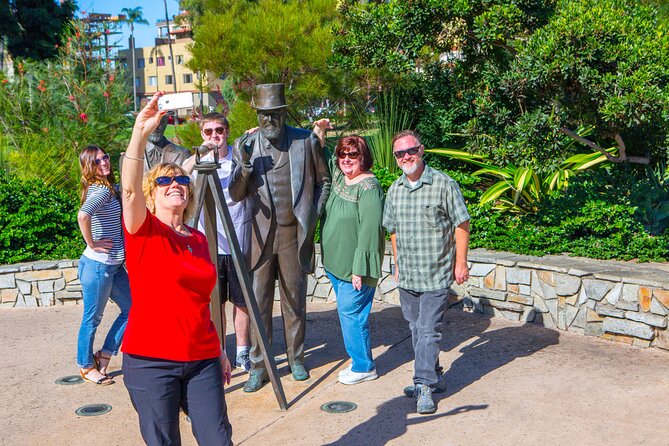
You’ll begin in the heart of Balboa Park, where El Prado acts like the park’s main spine. The first stretch is your orientation phase—about 50 minutes—and it’s the part that makes the rest of the tour click.
Expect architecture, gardens, and cultural buildings packed close enough that you can actually absorb what you’re looking at. The guide keeps you moving with a clear reason for every turn, which is huge in Balboa Park. Without that structure, it’s easy to drift and then realize you skipped the very details that make the park famous.
Bring your camera, but don’t treat it like a photo marathon. The best moments are the ones where the guide points to something specific—ornate facades, garden design choices, and sightlines—so you know what you’re capturing.
Quick practical tip
Wear shoes that are comfortable for walking on a mix of paths and museum-courtyard surfaces. This tour is not a “sit on a bus” day.
Cabrillo Bridge views: downtown, zoo, and the historic highway
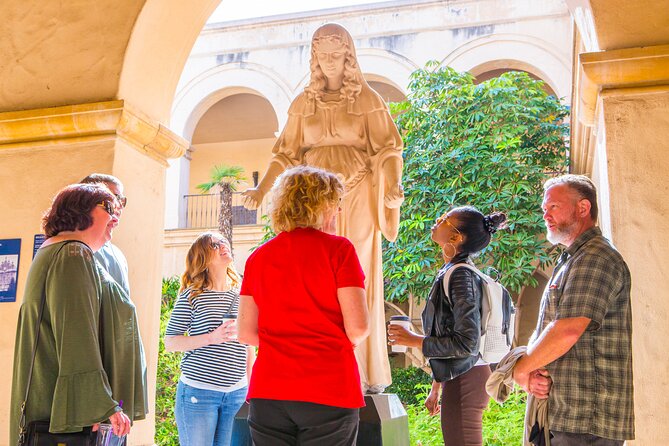
Next comes a short pause at Cabrillo Bridge. It’s only about 5 minutes, but it’s a smart time investment. You’ll stop on the walk across and look out over downtown San Diego, the San Diego Zoo, and the historic highway below.
This is one of those breaks that’s useful even if you’re not obsessed with architecture. It gives you a geography check. Once you know what you’re seeing from up high, it becomes easier to understand how Balboa Park sits in the city and why certain directions feel like natural routes.
If you’re traveling with people who don’t love museums, this stop is a good compromise. It’s scenic and quick, and it gives everyone a breath before you return to the park’s cultural landmarks.





The California Tower: where the park’s story turns into skyline views
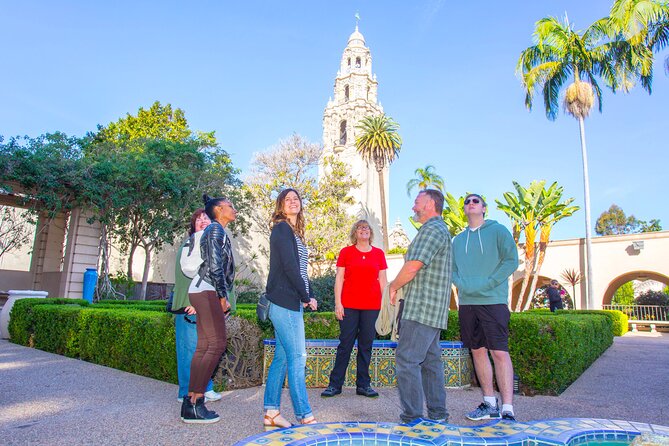
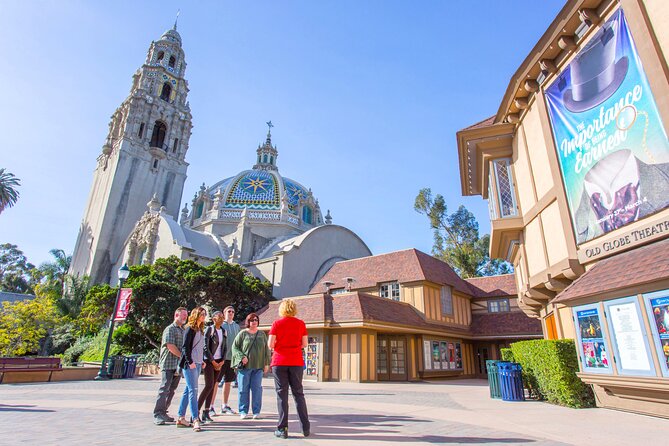
Then you’ll hit one of Balboa Park’s headline structures: the California Tower. It’s close to 200 feet tall and tied directly to the 1915 Panama-California Exposition. The guide also connects what you see on the tower’s ornate facade to the story of San Diego’s founding.
You’ll spend about 5 minutes here, but the tour is organized so you get three great views of the tower. That’s the right rhythm for a highlight stop. You get enough time to notice the details, and enough angles to understand why it’s such a signature landmark.
A potential drawback: if you’re hoping for a long, slow tower session, this tour won’t do that. This is a “see it and understand it” stop, not a “spend an hour reading every plaque” plan. If you want deeper time at one building, the resource list you receive after the tour becomes your friend.
Alcazar Garden and the art of copying good ideas
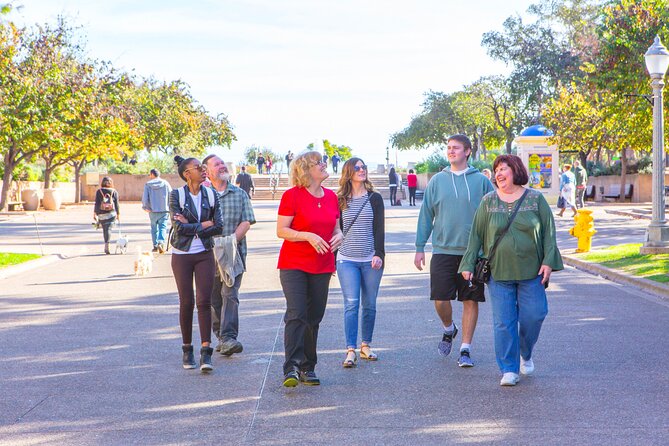
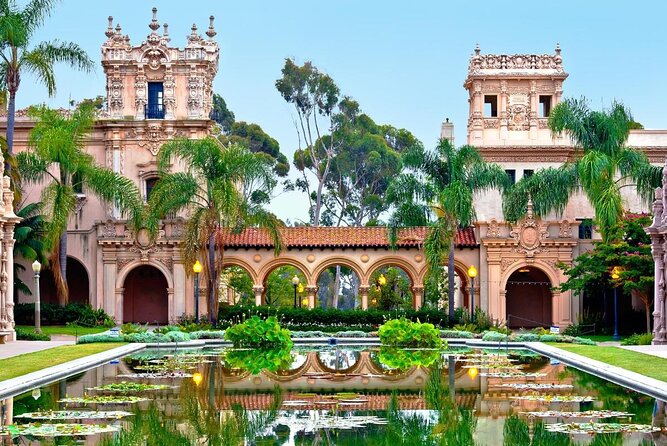
Next is Alcazar Garden. It traces back to the 1915 Exposition, and then later was redesigned for the 1935 Exposition, inspired by the Alcazar Gardens in Seville, Spain.
Even in a brief stop, the garden works as a lesson in design transfer. The idea isn’t that the park repeats Spain perfectly. It’s that Balboa Park has always been about bringing the world’s best ideas into a San Diego setting.
If you like photography, gardens are where your images start looking less generic. Look for symmetry, path curves, and how the plants frame views toward buildings. The guide helps you notice what looks “pretty,” but also what was chosen for a purpose.
Old Globe Theatre: arts details plus practical ticket tips
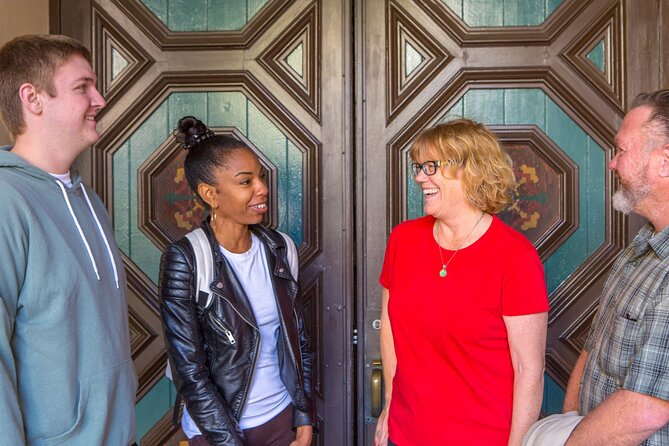
At the Old Globe Theatre complex, you’ll learn how three theaters in the area have been wowing audiences since construction tied to the 1935 California Pacific International Exposition.
This stop lasts about 5 minutes, which means you’re not here for a full show—this is about context. The guide shares the scoop on getting tickets when shows are in production, which is a big help because Balboa Park’s theater calendar is the kind of thing you can miss if you’re just walking around.
I like this stop because it connects the park’s past to what’s still happening now. You’re not only touring “history buildings.” You’re learning how the park functions as a working cultural campus.
Plaza de Panama Fountain: where the tour sends you to eat and explore

The tour moves next to Plaza de Panama Fountain. This is an easy stop to enjoy because it’s surrounded by options—cultural organizations, plus places to grab food.
You’ll only get about 5 minutes, but the guide uses that time to set you up for after the tour. You’ll get details on where to go next depending on what you like—museums, gardens, architecture, or just places to refuel.
This stop is also one of those “human-scale” moments. After looking up at towers and facades, a plaza gives your brain a chance to reset. It’s a simple win.
Botanical Building and Lily Pond: koi spotting plus an old building that still works
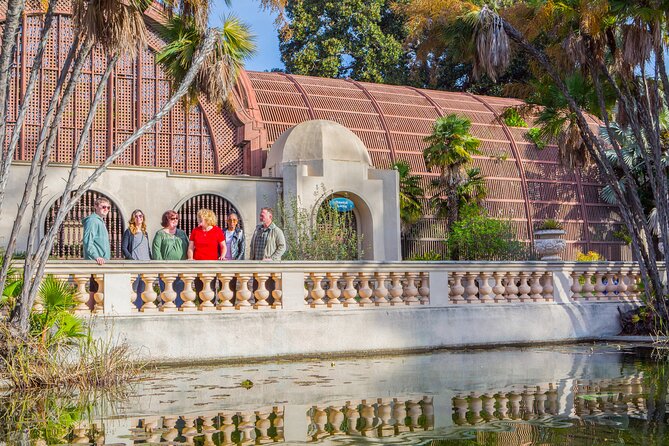
Now you’ll spend about 10 minutes at the Botanical Building and Lily Pond. This building was the largest of its kind when it was built for the 1915 Exposition, and it’s one of the buildings designed to last beyond the events.
In front, there’s a historic pond where you may spot koi and other wildlife. That’s the kind of moment that makes the park feel alive instead of staged. If you’re visiting with kids, this stop usually lands well because it offers something to watch without needing tickets or a long wait.
One realistic consideration: wildlife can’t be guaranteed. If you don’t spot koi right away, don’t let it ruin the moment. Just watch the water and enjoy the building’s grand greenhouse feel.
Spanish Village Art Center: cottages, studios, and creative energy
The Spanish Village Art Center is next, with about 10 minutes to explore. It’s made up of colorful cottages built for the 1935 California Pacific International Exposition, and it houses 37 studios.
This stop is more than a photo stop. It’s a chance to see how art is embedded into the park’s daily life. Even when you’re just walking through, the feeling is different than a standard museum layout.
The tour notes you’ll have a chance to explore the village and grab a beverage too. Since the tour already includes one drink at a local coffee cart, I treat this as extra optional time—more of a “browse and soak it in” stop than a second planned coffee break.
Moreton Bay Fig Tree: the kind of shade you’ll remember
One of the best “pause and look up” moments is at the Moreton Bay Fig Tree. It was planted for the 1915 Exposition, and the tour brings you close thanks to a viewing platform.
A big tree is a sensory anchor in a place like Balboa Park. It gives you scale, and it helps you understand how the park has grown into its current look. Also, it’s a great stop for anyone who’s tired of constant buildings and wants something nature-centered without leaving the main route.
If you’re traveling with older adults or anyone who needs frequent resting points, this stop helps because it’s easy to take in slowly.
Bea Evenson Fountain: kids, dogs, birds, and one clever feature
Next is the Bea Evenson Fountain, named for the founder of the Committee of One Hundred. The area tends to attract children, dogs, and birds, so expect a lively feel.
You’ll get about 5 minutes, and the guide points out a surprising feature that’s activated by the Fleet Center next door. That kind of detail is exactly why a tour is useful. On your own, you might not notice the cue that makes the fountain more playful.
This is a good spot for a quick reset. After tall buildings and long sightlines, the fountain brings you down to eye level.
Casa del Prado and El Prado: the park’s design logic in plain sight
Finally, the tour rounds out with Casa del Prado and El Prado. Casa del Prado is about 5 minutes, and the guide focuses on how the building acts as a hub for cultural and botanical organizations. It also highlights the park’s architectural idea: detailed design that was created quick and cheap. That’s a fascinating angle because it shifts how you look at the ornamental parts—you start noticing the craft behind the efficiency.
Then you’ll end at El Prado itself, the main area of the 1915 Exposition. Expect ornate buildings and architectural details that make the park feel like an outdoor museum of design choices. This is where your “why is this here?” questions get answered.
If you’re the type who wants a final photo that looks like you actually know what you’re photographing, save some phone storage for this stretch.
Who should book this Balboa Park highlights tour?
This tour fits best if you want:
- A clear introduction to Balboa Park’s layout in about 2 hours
- A guide who ties together architecture, gardens, and exposition-era design
- A small-group walk that includes a real break with coffee
- Practical guidance on enjoying what’s around you, not just seeing a list of buildings
It’s also a good choice if you’re not staying long. Balboa Park can swallow a day whole. This gives you a structured sampler, then helps you choose what to do next using the park resource list you receive.
Where it may not be your best match: if you want lots of museum entry time or extended time sitting in one gallery. This is a walking highlights plan, not a “spend all afternoon inside buildings” schedule.
Price vs. what you actually get for $60
At $60 per person for about 2 hours, the value comes from three things working together:
- You pay for a local guide to keep you from getting lost in the park’s scale. That time saved is real.
- You get a coffee cart beverage included, which would cost you anyway during a self-guided visit.
- You receive an exclusive park resource list so you can keep exploring after the tour with better decisions.
Also, the experience is capped at 15 travelers, so you’re not paying for a crowded group lecture. And it’s offered in English, with mobile ticketing for easy check-in.
One timing note: it’s often booked about 27 days in advance, so if Balboa Park is a must-do for your trip, don’t leave it to the last week.
Should you book this Balboa Park highlights tour with coffee?
Book it if you’re visiting Balboa Park for the first time or you’ve been a couple of times but never really connected the dots. The route is designed to help you understand why the park looks the way it does—down to the exposition references and the specific landmark logic.
Skip it or consider a different plan if you want lots of indoor museum time, or if your schedule is so tight that you can’t comfortably arrive early and walk at a steady pace.
If you do book, show up ready: bring comfortable shoes, keep your camera handy, and arrive with enough buffer for parking. You’ll finish the tour with a much better sense of where everything is—and you’ll know how to keep enjoying Balboa Park long after the coffee cup is empty.
FAQ
How long is the Balboa Park highlights tour?
It runs about 2 hours.
How much does the tour cost?
The price is $60.00 per person.
What’s included in the price?
You get a professional guide, one beverage at a local coffee cart, and an exclusive resource list with recommendations for enjoying the park after the tour.
Is admission required for the stops?
The stops listed on the tour route note admission ticket is free.
Where do I meet the guide?
The start meeting point is 698 El Prado, San Diego, CA 92103 and the tour ends at 1350 El Prado, San Diego, CA 92101.
What if I need accessibility help or have special equipment needs?
The tour notes that service animals are allowed and that most travelers can participate. If you want an audio system, you should let the provider know in advance.
Is there a cancellation option if plans change?
Yes. You can get a full refund if you cancel up to 24 hours in advance of the experience’s start time.